Myrrha
Myrrha is a figure from classical mythology who appears in Dante's Inferno as a damned soul in the Tenth Bolgia of Malebolge, punished among the Falsifiers for the sin of counterfeiting her own identity to commit incest with her father. Her presence in the poem illustrates the Inferno's theme of fraudulent love and the contrapasso that distorts the sinner's very nature.
Identity and Mythological Background
Myrrha is the daughter of Cinyras, king of Cyprus, who in Ovid's Metamorphoses conceived an incestuous passion for her father. To consummate this desire, she disguised herself as another woman and slept with him, a deception that Dante treats as a form of falsification—the counterfeiting of her own person. In the Inferno, she is described as "the ancient ghost / Of the nefarious Myrrha, who became / Beyond all rightful love her father's lover" (E07363-E07365). The poet emphasizes that she "came to sin with him after this manner, / By counterfeiting of another's form" (E07366-E07367), directly linking her crime to the category of falsification that defines the Tenth Bolgia.
Punishment in the Tenth Bolgia
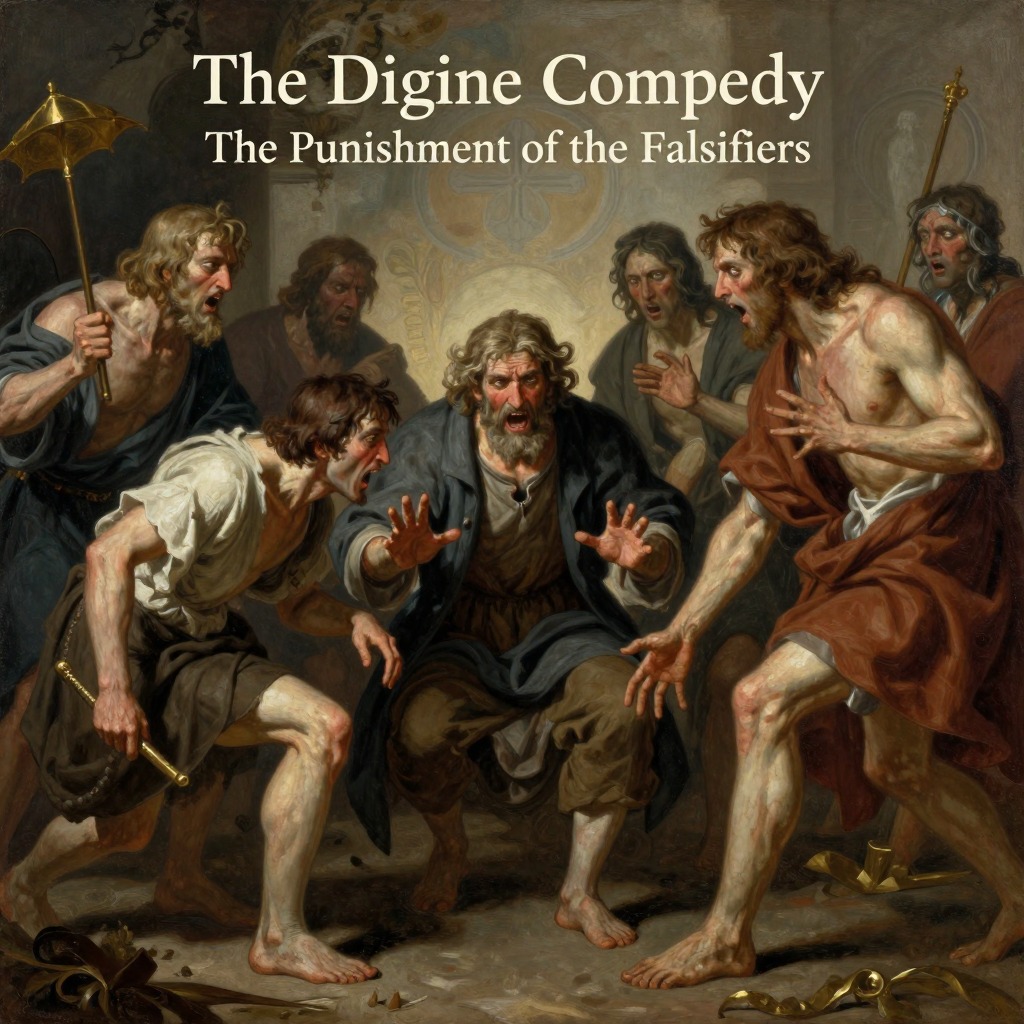
Myrrha is condemned to the Tenth and final Bolgia of Malebolge, where the Falsifiers—alchemists, counterfeiters, perjurers, and impersonators—suffer torments of disease and madness. She appears among the raving shades, described as one of "two shadows pale and naked, / Who, biting, in the manner ran along / That a boar does, when from the sty turned loose" (E07363-E07364). Her punishment is a form of bestial madness that mirrors the unnatural character of her sin: just as she disguised her true identity to commit incest, so now she is stripped of all human semblance and reduced to a frenzied, animalistic state. The contrapasso transforms her fraudulent love into a rabid, uncontrolled violence that she inflicts on others.
Role in the Narrative
Myrrha appears in Canto XXX of the Inferno, during Dante's tour of the Tenth Bolgia. She is identified by Griffolino d'Arezzo, an alchemist from Siena who points her out to the pilgrim. Griffolino explains that Myrrha "raving goes thus harrying other people" , emphasizing the mindless aggression that characterizes her punishment. Her presence serves as a counterpart to Gianni Schicchi, another falsifier who also counterfeited a person's identity—Schicchi impersonated Buoso Donati to forge a will, while Myrrha impersonated a fictional woman to deceive her father. Together, they illustrate the Inferno's systematic condemnation of fraud in all its forms, from the falsification of metal to the falsification of the self.
Thematic Significance
Myrrha's punishment embodies the Inferno's moral logic that the sin of fraud—the deliberate corruption of truth and trust—is punished by a corresponding corruption of the sinner's own nature. Her incestuous desire, which she could only fulfill by pretending to be someone else, is repaid by a madness that erases her human identity entirely. The poet's choice to place her among the Falsifiers rather than among the Lustful (where she might have been grouped with Francesca da Rimini or Cleopatra) underscores that Dante considers the means of her sin—deception and impersonation—more grievous than the desire itself. Her story also serves as a warning about the dangers of uncontrolled passion, which can drive a person to abandon not only moral law but also the very integrity of the self.